Why “Scope paragraph, Perspectives paragraph, Methods paragraph, Ethics paragraph” is the most common way to lose marks in TOK — and what to do instead.
The mistake almost every DP1 student makes!
Give a Year 1 TOK class the knowledge framework — scope, perspectives, methods and tools, ethics — and within a week you will see the same essay shape appear in every single submission:
Introduction.
Paragraph 1: Scope.
Paragraph 2: Perspectives.
Paragraph 3: Methods and Tools.
Paragraph 4: Ethics.
Conclusion (which restates paragraphs 1–4).
It looks organised. It feels safe. The student can tick four boxes, the teacher can tick four boxes, and everyone leaves the marking feeling like something rigorous happened.
Nothing rigorous happened. What happened was a description of four topics, stapled together in a fixed order. The argument never went anywhere, because there was never an argument — there was a checklist.
What the framework actually is
The IB’s own Theory of knowledge guide (first assessment 2022) is unusually clear about this, if you read the sentence carefully:
The knowledge questions suggested for each theme and area of knowledge are organized into a “knowledge framework” consisting of four common elements:
scope,
perspectives,
methods and tools,
and ethics.
These four elements provide a structure to help students explore and analyse the different aspects of the course, as well as providing a common vocabulary to help encourage comparisons and connections.
Two words do all the work there: vocabulary and connections.
The framework is not a table of contents for your essay. It is a set of four questions you can ask about any piece of knowledge. Its whole purpose is to give you a shared language so that when you are comparing, say, how historians and mathematicians handle bias, you are not inventing a new vocabulary from scratch — you can say “on the question of methods and tools, these two areas diverge in this specific way.”
The guide says it even more bluntly in the section on making comparisons across areas of knowledge: the framework “is intended to help support comparisons across areas of knowledge.” It is a tool for putting two things side by side and interrogating them. It was never designed to be a paragraph template.
Why the four-paragraph structure quietly destroys your essay
The TOK essay is marked by global impression marking. There is one driving question:
Does the student provide a clear, coherent and critical exploration of the essay title?
Not “did the student mention four things.” Clear, coherent, critical, exploration. Read those four adjectives as a warning label on the four-paragraph structure.
“Clear and coherent” means the paragraphs exist because the argument demands them. Each paragraph should be doing a job in a chain of reasoning: making a claim, supporting it, meeting an objection, sharpening a distinction. In the four-paragraph version, paragraphs are ordered by the framework’s sequence, not by the logic of the case. So paragraph 3 does not follow from paragraph 2 — it just comes next alphabetically. Coherence dies by arrangement, not by error.
“Critical” means evaluation, not identification. The guide is explicit that comparing areas of knowledge “is also an evaluative task, as opposed to being simply descriptive… rather than simply their identification.” Writing “the methods used in the natural sciences include controlled experimentation, which has strengths and limitations” is identification. Writing “controlled experimentation gives the natural sciences a form of justification that history cannot achieve, but the price is that the question being answered has already been narrowed by the experimental design — so the reliability is real but domain-bounded” is evaluation. The four-paragraph structure pushes students toward the first, because a paragraph whose title is “Methods and Tools” rewards describing methods, not using them as leverage.
“Exploration” means the student found something they did not already know when they started typing. A checklist cannot explore. It can only report.
And there is an arithmetic problem too. On an 800-word draft, four framework paragraphs plus an introduction, a conclusion and real examples leaves roughly 150 words per element. That is a definition, one example, and a sentence of hedging. Depth is not optional at that length — it is arithmetically impossible.
The tell-tale signs your essay has been templated
If any of these are true, the framework has stopped being a lens and become a layout:
- Your paragraph topic sentences are the names of the elements. (“In terms of perspectives…”)
- You could swap paragraphs 2 and 3 and the essay would still read the same. If the order is interchangeable, there is no argument.
- Every element gets roughly the same number of words, regardless of whether it matters to the question.
- Your conclusion restates the four sections instead of landing a judgement.
- You never say which area of knowledge you are actually discussing. (3/6)
- Your “ethics” paragraph debates whether the thing is good or bad, instead of asking a question about knowledge.
That last one deserves its own warning. The guide specifically instructs that TOK discussions of ethics must focus on “the knowledge questions that are woven into, and implied in, the ethical issues being discussed, rather than the focus being on debating the ethical issues themselves.” An ethics paragraph about whether veganism is healthy is not TOK. An ethics paragraph about whether a nutritional claim’s healthiness can be settled independently of the cultural values that selected which outcomes to measure — that is TOK.
How to use the framework properly
001. Start from the question, not from the framework.
Ask what the title is actually pressing you to decide. Decide what you think. Only then go shopping in the framework for the tools that will get you there.
002. Pick the two elements that do the most work — and say why.
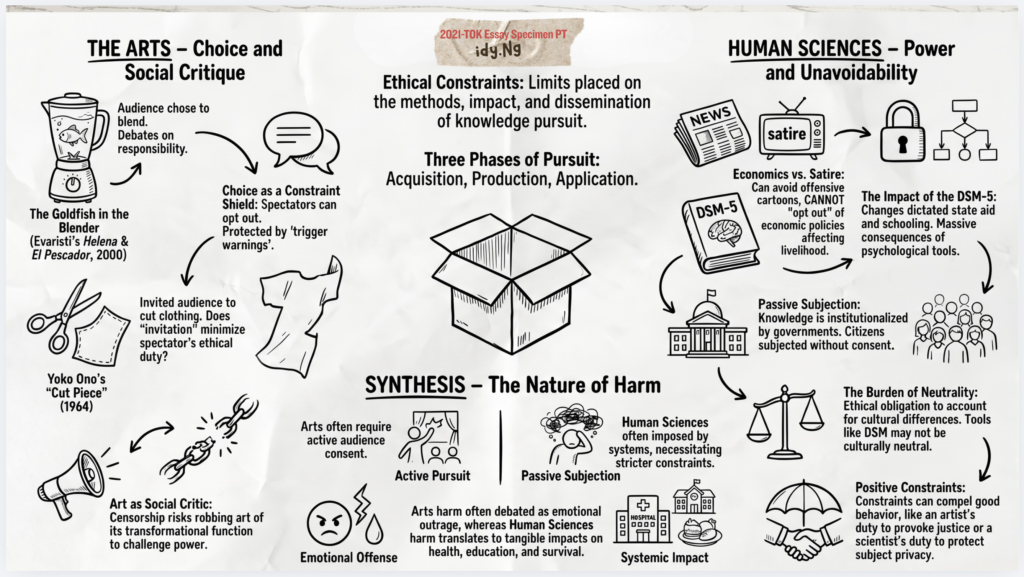
For a question about whether mathematical knowledge is discovered or invented, perspectives and methods and tools are where the action is; scope and ethics will barely move the needle. For a question about misinformation in politics, ethics and perspectives are load-bearing. Choosing two and going deep is a stronger essay than covering four and going shallow. Coverage is not a marking criterion. Critical exploration is.
003. Make the elements talk to each other.
The best paragraphs are not “an element paragraph” — they are a tension paragraph, where two elements collide. For example: the methods of climate science produce high-confidence projections, but the ethics of policy action require decisions before that confidence exists. Now you are reasoning, not reporting. The framework’s real design logic is that the four elements run through every theme and area, which is precisely what makes them comparable — use that.
004. Anchor everything in named areas of knowledge.
The prescribed titles all end with “Discuss with reference to two areas of knowledge.” The framework is the vocabulary; the AOKs are the evidence. A framework essay with no AOK in it is a discussion of opinions.
005. Let the paragraph order follow the argument.
If the strongest move in your case is a comparison of methods, put methods first. If you need to establish what the area is even claiming before you can challenge it, that is your scope move — put it first because the logic needs it, not because scope is listed first in the guide.
A quick before / after
Templated (weak):
Paragraph 2 — Perspectives. “There are different perspectives on climate change. Scientists, politicians and the public all see it differently. These perspectives influence how we understand the issue.”
Framework as a lens (strong):
“The three communities disagree less about the data than about what the data licenses them to do, and that gap is itself a knowledge problem: the modelling methods of the natural sciences yield confidence intervals, not policy thresholds, so the move from ‘projected 1.5 °C’ to ‘we must act now’ is not a further measurement but a judgement contributed by knowers outside the scientific community — which means the certainty of the science and the urgency of the policy are answering two different questions.”
Same four elements in play. Completely different essay.
The one-sentence rule
Use the framework to think about the question; do not use the question as an excuse to visit the framework.
If your reader can tell which element each paragraph is about before they read it, you have written a book report on the TOK syllabus. If your reader can tell what you think, and why, and where the difficulty really lies — then the framework did its job, and you never needed to name all four.
One last thing, before you write
There is a line by the American philosopher William James that every TOK student should read before they start drafting. It comes from The Principles of Psychology (1890), the chapter where he describes how the mind works on a world that gives us far more information than any mind can hold:
“The art of being wise is the art of knowing what to overlook.” — William James, The Principles of Psychology (1890), Ch. 22
Read that as permission, not as a warning. You are not being asked to know everything about knowledge. You are being asked to choose. Four elements, five areas of knowledge, thirty-five prompts, a hundred and sixty years of philosophy — none of it fits into 1,600 words, and none of it is meant to.
The strength of a TOK essay has never come from how much of the syllabus it managed to mention. It comes from what you decided to look closely at, and what you were confident enough to leave on the table. So pick the two elements that matter to your question. Leave the other two out, and don’t apologise for it. That isn’t a gap in your coverage. That is the beginning of judgement — and judgement is the whole point of the course.
Write the essay that only you could have written from the things you actually care about. That is the one the examiners are hoping for.
~ Ms Idy